
A day is born
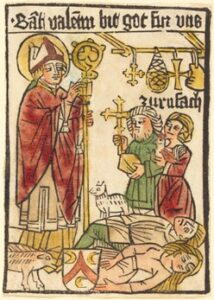
St. Valentine secretly marrying Christians in ancient Rome
From its ancient origins as Lupercalia, a mid-February Roman Pagen festival celebrating fertility, purification, rebirth, and the approaching spring, Valentine’s Day has long carried symbolic weight. While its earliest interpretation had little to do with romance as we understand it now, the timing itself—mid-winter, on the edge of renewal—became enduringly linked to ideas of pairing, companionship, and love.
Several Christian martyrs named Valentine appear in early church records, but one legend in particular took hold. St. Valentine was a priest who secretly performed marriages for Christian couples during a period when Christianity was outlawed in Rome. Talk about giving it all for love! He was executed for his troubles around February 14, 269 AD. While historians debate the details, the story mattered less for its accuracy than for what it represented: a connection between love, commitment, and ceremony.
In the centuries that followed, the Catholic Church is believed to have reframed Valentine’s feast day, gradually associating it with devotion, partnership, and moral commitment. By the Middle Ages, poets and writers had firmly linked mid-February with a time for public declarations of love, transforming Valentine’s Day into a moment for declaring affection and intent.
When private affection becomes public
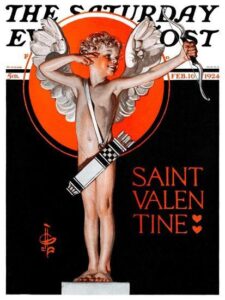
Cupid as a symbol of love was invented by illustrator JC Lynedecker in 1924 for the Saturday Evening Post
Valentine’s Day has become the moment when private feelings often turn into publicly declared commitments. Around 145 million Valentine’s Day cards are exchanged every year, making it the second-largest card-sending occasion of the year after Christmas. That’s why it’s also one of the most popular dates in the US for proposals, with an estimated 220,000 engagements—roughly 6% of all annual engagements—happening on or around February 14. Even more such questions are popped and answered in the days immediately before and after, turning the weeks before and after Valentine’s Day into what some wedding planners call engagement season.
So, question asked and answered (yes), then what?
An engagement party.
Weddings, regardless of trends, still tend to follow certain expectations. They’re family-oriented, carefully structured, and shaped by tradition.
Engagement parties are different. They’re more relaxed, more flexible, and more personal. Their appeal lies in that freedom. With almost no rules they can be hosted by friends, family, or more often than not these days, the couple themselves. As people marry later, are more financially stable, and have often been together for several years (statistically three to five) they’re comfortable doing things their own way from the very beginning.

Engagement Parties can range from cocktail parties to casual dinners, barbeques, or pizza.
Typically held a few months after the engagement, invitations can be sent digitally, the guest list can be expansive, and the tone is entirely up to the hosts. As weddings themselves become more elaborate—and expensive—an engagement party offers a way to celebrate freely without the pressure of formal roles, rigid etiquette, or predetermined expectations.
It’s also a graceful way to share big news with a wider circle. Friends, coworkers, and extended family who may not be part of the wedding day can still be included in the joy of the moment.
Food, drink, and entertainment follow the same philosophy. Some couples opt for dressy cocktail parties with appetizers and an open bar. Others choose beer and barbecue, pizza, food trucks, or something entirely unexpected. Dress is usually casual. The focus is fun, connection, and celebration, not formality.
There is one widely accepted rule: no gifts. Unlike almost every other aspect of a wedding, an engagement party is for the guests. The happy couple want to announce and share their joy by bringing it to others.
And to kick it all off…
A celebration that allows such flexibility is even better when the hosts are free of any responsibility making a list and sending out an evite. Ball Event Center offers spaces that can accommodate parties as small as 50 and as large as 300, with a professional grade kitchen, amenities, and a roster of approved vendors experienced with events of all kinds.
Sound systems, bars, tables, chairs, stages… Ball has whatever’s needed to make the first celebration of a newly engaged couple’s future one to remember. An engagement party at Ball Event Center turns that first private “yes” into the first public declaration of love and commitment, and fun for all!
Schedule your tour today, contact us today!